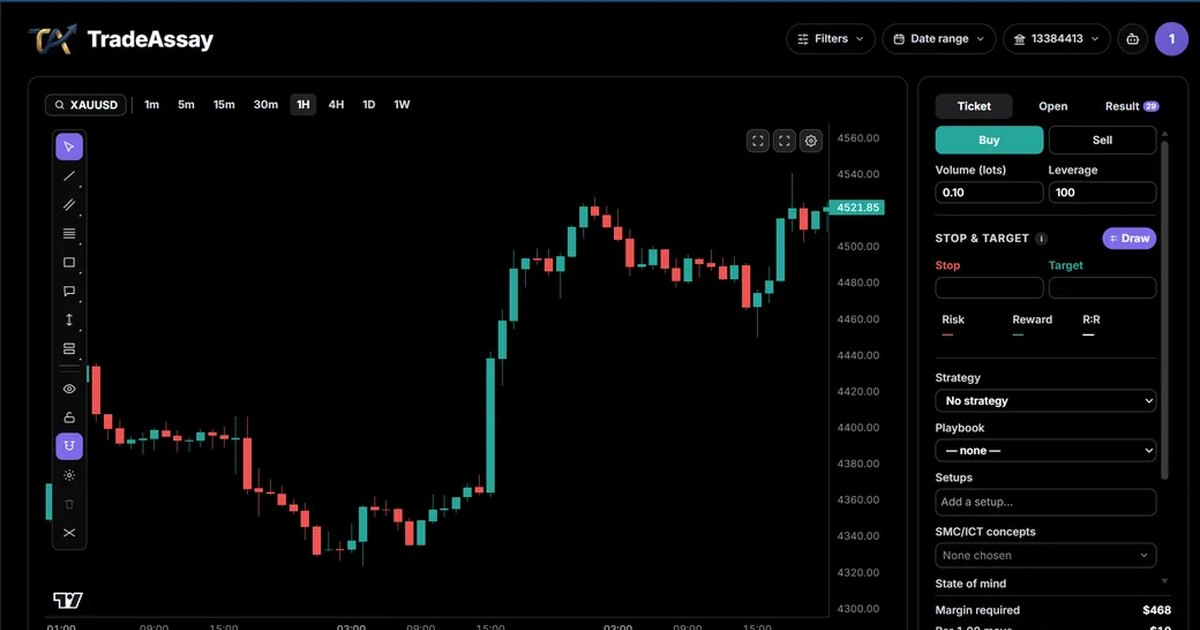
Proprietary trading has become increasingly popular among traders who want to access larger amounts of trading capital without relying entirely on their personal funds. However, trading with a prop firm comes with specific expectations, including disciplined risk management, consistent execution, and careful attention to account rules. Traders may have access to significant capital, but maintaining an account can be just as challenging as obtaining it. This makes a prop firm trading journal a valuable tool for traders who want to understand their performance and develop better trading habits.
A trading journal is more than a simple record of winning and losing trades. It creates a structured history of decisions, market conditions, strategies, risk levels, and outcomes. For prop traders, this information can become particularly useful because even a few poor decisions can have a significant impact on account performance.
A prop firm trading journal can help traders evaluate whether they are following their trading plan, managing risk appropriately, and maintaining consistency. Instead of relying on memory or emotions, traders can review actual historical data to understand their strengths and weaknesses.
Whether a trader participates in forex, futures, stocks, indices, or another financial market, keeping detailed trading records can support continuous improvement. A journal cannot guarantee profits or ensure that a trader will pass a prop firm evaluation, but it can provide greater awareness and accountability throughout the trading process.
Prop firm trading journal for better trade tracking
Prop firm trading often requires traders to follow predetermined rules related to account losses, drawdown, position sizing, and overall performance. These conditions make trade management especially important. A prop firm trading journal provides a practical way to record trading activity and review decisions against a trader's personal strategy and account requirements.
Trade tracking should include more than the final profit or loss. The reasoning behind a position can provide important information when reviewing performance. A trader can record the market setup, entry point, expected target, stop-loss decision, position size, and conditions that influenced the trade.
Over time, these records can reveal useful patterns. A trader may discover that certain setups perform consistently during specific market sessions, while other strategies produce weaker results. Another trader may recognize that losses frequently occur after entering positions without sufficient confirmation.
This type of information can improve decision-making because it allows traders to rely on evidence rather than assumptions. Instead of believing that a strategy is effective simply because it recently produced a profitable trade, traders can examine a larger sample of historical positions.
A prop trading journal can also help traders understand their execution. Sometimes the strategy itself may not be the main problem. A trader might have a reasonable setup but enter too early, move the stop-loss unnecessarily, or close a profitable position before the planned target.
Documenting these details makes execution mistakes easier to recognize. Once a recurring issue becomes visible, traders can focus on correcting the specific behavior rather than completely changing their trading strategy.
Trade tracking also creates accountability. When every position is documented, traders can compare their actual actions with their planned rules. This can be especially valuable after a difficult trading session because emotions can make it easy to forget the circumstances surrounding a decision.
A well-maintained prop firm trading journal therefore becomes a historical record of both market activity and personal behavior.
Risk management and trading discipline
Risk management is one of the most important aspects of proprietary trading. Prop firms may establish limits that require traders to carefully control losses and account exposure. Even a strategy with a strong historical performance can become problematic if the trader takes excessive risk.
A prop firm trading journal can help traders monitor how risk affects their results. By recording position sizes, stop-loss levels, potential risk, and actual outcomes, traders can identify whether their risk-taking behavior remains consistent.
This is particularly important after winning trades. A series of successful positions can increase confidence, but excessive confidence may encourage a trader to increase position sizes or take setups that would normally be ignored. Reviewing journal records can help identify whether risk levels change during winning streaks.
The same principle applies after losses. Losing trades can create frustration and encourage revenge trading. A trader may attempt to recover a loss immediately by taking larger or less carefully planned positions. In a prop firm environment, this behavior can potentially place the entire account at unnecessary risk.
A trading journal allows users to identify these patterns by connecting individual trades with the circumstances surrounding them. Traders can record their emotional state, reasoning, and level of confidence before entering a position. Later, they can compare these observations with actual results.
Emotional discipline is often underestimated in trading. Fear, greed, impatience, and frustration can influence even experienced traders. A journal does not remove these emotions, but it can make their effects easier to recognize.
For example, a trader may notice that the largest losses consistently occur after an earlier losing position. This could indicate a pattern of revenge trading. Another trader may discover that they frequently close winning trades too quickly because of fear that the market will reverse.
Identifying these behavioral patterns can lead to practical improvements. Traders can introduce stronger rules around position sizing, trade frequency, breaks, and entry confirmation.
The prop firm trading journal can therefore support both technical performance and psychological discipline. It encourages traders to evaluate not only the market but also the decisions they make within that market.
Strategy analysis and prop firm performance
A major benefit of a trading journal is its ability to support strategy analysis. Traders often use different approaches involving price action, technical indicators, market structure, trend analysis, momentum, or support and resistance. However, having a strategy does not automatically mean that it will perform equally well in every market environment.
A prop firm trading journal allows traders to compare strategy performance across different conditions. Historical records can show whether a particular setup works better during trending markets, periods of consolidation, or higher-volatility sessions.
This information can help traders become more selective. Rather than entering every possible setup, they can focus on the situations where their trading approach has historically demonstrated stronger results.
Trading performance analysis can also reveal differences between instruments. A trader might perform well with one currency pair but struggle with another. A futures trader may discover that certain contracts better match their preferred trading style.
These insights can help create a more focused trading plan. Instead of trying to trade everything, traders can concentrate on the markets and setups they understand best.
A trading journal is also useful for evaluating consistency. A trader may have several profitable days but still experience large drawdowns because of occasional aggressive trading. Looking at the complete record can reveal whether performance is stable or dependent on a small number of successful positions.
This broader perspective is especially important for prop traders. The objective should not simply be to achieve short-term profits but to develop a repeatable process that respects account restrictions and manages risk.
Journal analysis can also help traders review previous prop firm challenges or evaluation attempts. If an evaluation was unsuccessful, the trader can examine their records to determine the underlying reasons. Perhaps they increased risk after losses, traded too frequently, ignored their strategy, or entered positions without sufficient preparation.
Learning from these experiences can make future attempts more informed. Instead of simply starting another evaluation and repeating the same behavior, traders can use historical information to make specific improvements.
Long-term growth with a prop trading journal
Obtaining a funded trading account is only one stage of a trader's development. Maintaining consistent performance requires ongoing learning, self-evaluation, and adaptability. A prop firm trading journal can become a long-term resource for this process.
As the journal accumulates more information, traders gain a larger dataset for analyzing their performance. They can compare weeks, months, strategies, market sessions, and trading conditions to identify broader trends.
Long-term records can reveal whether a trader is becoming more disciplined. They can also show whether risk management has improved and whether repeated mistakes are becoming less frequent.
A trading journal can become part of a daily trading routine. Before beginning a session, a trader can review previous results and reinforce their trading plan. After the session, they can record completed trades and reflect on the quality of their execution.
This process encourages traders to focus on process rather than short-term outcomes. A single losing trade does not necessarily indicate a bad strategy if the trade followed the established rules and risk parameters. Similarly, a profitable trade does not necessarily represent a good decision if it resulted from excessive risk or an impulsive entry.
This distinction is important for professional trading development. The goal is to create a repeatable process that can produce sustainable results while controlling risk.
Digital trading journals and performance tracking tools can make this process more convenient. Traders can organize historical records, analyze performance, and monitor their progress without relying on scattered notes.
However, the effectiveness of any prop firm trading journal depends on how honestly and consistently it is used. A journal filled only with successful trades will not provide an accurate picture of performance. Losing trades, mistakes, emotional decisions, and missed opportunities can all provide valuable lessons.
Over time, a detailed journal can become a personal trading database. It can show not only what happened in the markets but also how the trader responded to those situations.
Conclusion
A prop firm trading journal can be an important tool for traders who want to improve discipline, strengthen risk management, and understand their overall performance. Proprietary trading requires careful attention to account rules, drawdown, position sizing, and consistency, making detailed trade tracking particularly valuable.
By recording trading decisions, strategies, market conditions, risk levels, and outcomes, traders can create a clearer picture of their strengths and weaknesses. Regular performance analysis can reveal recurring mistakes, successful setups, emotional patterns, and opportunities for improvement.